


What Does It Mean to Invest in Startups?
Startup investing means putting money into a young company with the expectation that the business will grow in value over time. Unlike buying shares of a large publicly traded company, startup investments are usually made in private businesses that may still be developing their products, building a customer base, or expanding into new markets.
The attraction is easy to understand. A successful startup can grow dramatically, and early investors may benefit if the company’s value increases or if the business is eventually acquired or goes public. However, that potential comes with substantial risk. Many startups never become profitable, and some fail completely, which means investors can lose some or all of their investment.
For that reason, startup investing should be approached differently from ordinary stock investing. It requires patience, research, risk assessment, and an understanding of how private-company investments work. The goal should not simply be to find the next famous startup but to understand what you are buying and why the opportunity may be worth considering.
Why Do People Invest in Startups?
One reason people invest in startups is the possibility of significant growth. A small company operating in a promising market can potentially increase its revenue and valuation much faster than an established business. If an investor gets involved at an early stage and the company performs exceptionally well, the investment can potentially become much more valuable.
Startup investing can also provide exposure to innovative industries. Investors may encounter companies working on software, artificial intelligence, healthcare technology, financial technology, renewable energy, consumer products, education, logistics, and many other emerging areas. For people interested in innovation, investing can be a way to participate financially in businesses they believe could influence the future.
There is also an element of diversification. Investors who already have a portfolio of traditional assets may consider private investments as one component of a broader strategy. However, startup investments are generally less liquid and more speculative than many publicly traded investments, so they should not automatically be treated as a simple substitute for stocks, bonds, or cash.
Understand the Risks Before Investing
The most important rule of startup investing or Invest in Startups is understanding that high potential returns come with high risk. A startup may have an impressive idea but still fail because of weak execution, insufficient funding, competition, regulatory problems, poor management, or changing customer demand.
Another major risk is illiquidity. When you buy shares of a publicly traded company, you can generally sell them through a market during trading hours. Startup investments are different. There may be no easy buyer for your ownership stake, and you could potentially have to wait years for a sale, acquisition, public listing, or another liquidity event.
Dilution is another issue investors need to understand. Startups often raise additional capital by issuing new shares. If you invest early and the company later issues more shares, your percentage ownership can decrease unless you participate in subsequent financing rounds. This does not necessarily mean the investment becomes worse, but investors should understand how future fundraising can affect ownership.
Decide How Much You Can Afford to Invest in Startups
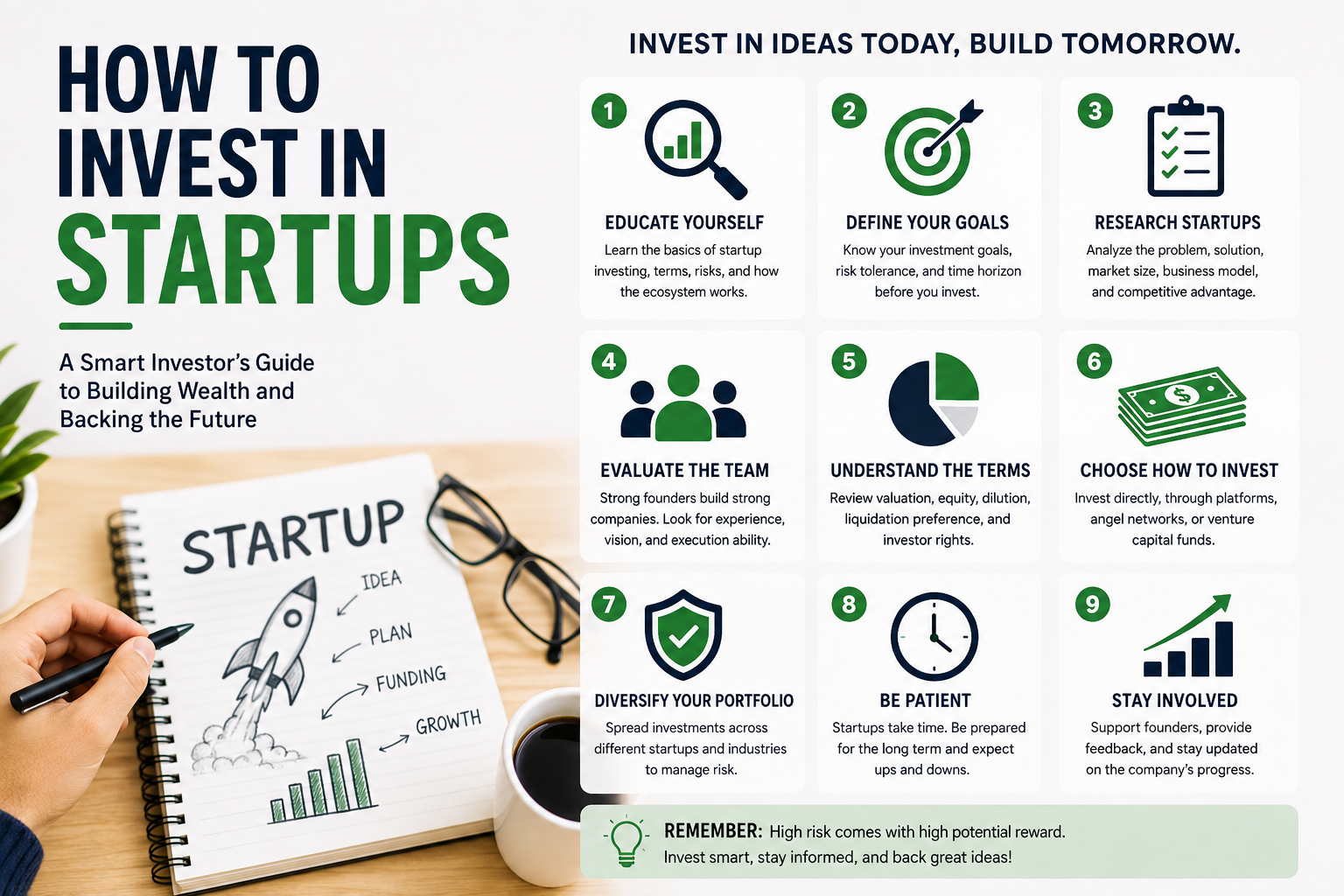
Before searching for startup opportunities, determine how much money you can realistically afford to put at risk. Startup investing should generally come after you have considered your essential financial obligations and other important financial goals. Money needed for rent, emergency expenses, debt payments, or short-term needs should not casually be committed to an illiquid investment.
It is also important for Invest in Startups to think about your overall portfolio rather than viewing a startup investment in isolation. If one startup represents a very large percentage of your available investment capital, the consequences of failure can be significant. Spreading risk across different assets and, where appropriate, multiple startup opportunities can reduce dependence on one company’s outcome.
There is no universal percentage that is suitable for everyone. Your financial circumstances, risk tolerance, investment horizon, and local regulations all matter. If you are uncertain about how startup investing fits into your finances, consider speaking with a qualified financial professional who understands private-market investments.
Choose the Right Way to Invest in startups
There are several ways investors may gain exposure to startups. One approach is investing directly in a startup when the company is raising capital. This can provide direct ownership or another type of security, depending on the deal structure and applicable laws.
Another route is using an investment platform or regulated crowdfunding platform where eligible investors can review startup offerings. These platforms can make private investing more accessible, but investors still need to perform their own research. The existence of an opportunity on a platform does not automatically mean that the company is a good investment.
Some investors gain startup exposure through venture capital funds or similar professionally managed vehicles. In that situation, the fund invests in multiple companies rather than the investor selecting each startup individually. This can provide diversification and professional management, although fees, eligibility requirements, liquidity restrictions, and investment minimums vary considerably.
Learn About Startup Investment Stages
Startups typically go through different financing stages as they develop. Very early companies may raise capital through pre-seed or seed financing. At this stage, the business might still be validating its idea, building an initial product, or finding product-market fit.
Later-stage startups may raise Series A, Series B, Series C, or subsequent rounds. As companies progress, they may have more customers, revenue, employees, and established operations. However, later-stage investing does not automatically eliminate risk. A company can still experience operational difficulties, fail to meet growth expectations, or struggle to become profitable.
The stage of investment can affect the company’s valuation, risk profile, ownership structure, and potential return. Investors should understand what stage they are entering and why the company is raising money at that particular point in its development.
Research the Startup and Its Business Model
Research should begin with the business itself. What problem is the company solving? Is the problem genuinely important to customers? Who pays for the product or service? How does the company make money? These basic questions can reveal whether the business has a practical commercial model Invest in Startups
Next, examine the market. A startup can have an excellent product but still struggle if its target market is too small or highly competitive. Look at the company’s competitors and consider what makes the startup different. A strong competitive advantage could involve technology, intellectual property, distribution, brand recognition, network effects, pricing, or another defensible factor.
Financial information deserves close attention as well. Depending on the company’s stage, investors may examine revenue growth, margins, operating expenses, cash reserves, customer acquisition costs, recurring revenue, and the rate at which the company spends cash. Early startups may not have extensive financial histories, but whatever information is available should be reviewed carefully.
Evaluate the Founders and Management Team
A startup’s founders can have a major influence on its success. Look at their experience, industry knowledge, previous businesses, technical abilities, and ability to execute. A great idea without capable leadership may not turn into a successful company.Invest in Startups
It is also worth considering how the founders respond to challenges. Startups operate in uncertain environments, so adaptability and problem-solving can be extremely important. Investors should look for evidence that the management team understands its customers and can adjust when assumptions prove wrong in Invest in Startups
The broader team matters too. A company with strong technical talent but weak sales capabilities may face a different set of problems from a business with excellent marketing but limited product expertise. Understanding the team’s strengths and weaknesses provides a more complete picture of the opportunity.Invest in Startups
Understand the Valuation
Valuation is one of the most important concepts in startup investing. It represents the estimated value of the company when an investment is made. A promising business can still be a poor investment if investors pay an excessively high price relative to its realistic future potential.Invest in Startups
Early-stage companies are often difficult to value because they may have limited revenue or no profits. Investors may therefore look at factors such as market size, growth rates, comparable companies, intellectual property, customer traction, and the terms of the financing round.
Do not focus only on the company’s headline valuation. Understand how much money is being raised, what percentage of the business the financing represents, and what type of security investors receive. The legal and financial terms can have a major impact on the eventual outcome.Invest in Startups
Understand the Investment Terms
Startup investments can involve different types of securities, including equity, preferred shares, convertible notes, or other structures. Each can have different rights and economic consequences. Investors should never assume that all startup investments work like ordinary common stock.
Important terms may include voting rights, liquidation preferences, conversion provisions, anti-dilution protections, information rights, and restrictions on transferring shares. These details can become especially important during future fundraising rounds or an acquisition.
Before committing money, read the relevant offering documents carefully. If you do not understand a particular term, get professional advice rather than relying on assumptions. Private investment documents can be complicated, and a seemingly small provision may significantly affect an investor’s position.Invest in Startups
Consider Diversification
Putting all your startup investment money into one company can create considerable concentration risk. Even a startup that appears extremely promising can encounter unexpected problems. Diversification cannot eliminate investment risk, but it can reduce the impact of one company’s failure on the overall portfolio Invest in Startups
Some investors who participate in private markets spread investments across multiple startups, industries, stages, or investment structures. The idea is that individual outcomes can vary dramatically, and a diversified approach may reduce dependence on one company’s success.
However, diversification should not mean investing randomly. Ten poorly researched investments are not necessarily better than one well-researched opportunity. The quality of the underlying businesses, the terms of each investment, and the investor’s overall financial strategy remain important.Invest in Startups
Be Prepared for a Long Investment Horizon
Startup investing usually requires patience. A young company may need many years to reach maturity, and there may be no immediate way to sell your investment. Investors should be comfortable with the possibility that their capital could remain committed for an extended period.Invest in Startups
Potential liquidity events can include an acquisition, merger, secondary transaction, or initial public offering. None of these outcomes is guaranteed. A startup may continue operating privately for many years without providing investors with an opportunity to sell.
This long-term nature makes startup investing unsuitable for money that you expect to need soon. Before investing, ask yourself whether you could comfortably leave the money invested even if the company takes much longer than expected to reach a major milestone Invest in Startups
Watch Out for Startup Investment Scams
Because startup investing involves private companies and potentially large returns, it can attract fraudulent schemes. Be particularly careful with opportunities that promise guaranteed profits, pressure you to invest immediately, or provide unrealistic return projections.
Always verify who is offering the investment and whether the opportunity is legally available to you in your jurisdiction. Check the company’s identity, management team, business operations, documentation, and regulatory information where applicable.
Avoid sending money simply because someone claims that a startup is “the next big thing.” Professional-looking websites, impressive presentations, and enthusiastic sales pitches do not replace proper due diligence. If the opportunity cannot withstand reasonable questions, that is itself a warning sign. in Invest in Startups
A Simple Startup Investment Checklist
Before investing, start by understanding the business. Identify its product, target customers, competitors, revenue model, market size, and major competitive advantages. You should be able to explain in simple language why you believe the company has a realistic opportunity to succeed.Invest in Startups
Next, examine the investment itself. Understand the valuation, security type, ownership structure, fundraising history, important terms, and potential dilution. Consider what could happen in both a successful scenario and a failure scenario.
Finally, review the investment in the context of your own finances. Consider whether you can afford to lose the invested capital, whether you can tolerate limited liquidity, and whether the investment fits your overall portfolio. Good startup investing is not about eliminating uncertainty; it is about understanding and managing it.
Final Thoughts
Learning how to invest in startups can open the door to an exciting part of the investment world, but it requires a different mindset from buying ordinary public-market shares. Startup investments can offer significant upside when companies succeed, yet the possibility of losing a substantial portion or all of the investment is real Invest in Startups
The strongest approach is to focus on research rather than hype. Study the business model, market, founders, financial position, valuation, investment terms, and potential risks. Understand that private investments can be difficult to sell and may require years of patience.
Most importantly, never invest money simply because a startup sounds exciting. A thoughtful investor looks at both the opportunity and the downside. With careful research, realistic expectations, proper diversification, and professional advice when necessary, investors can make more informed decisions about whether startup investing belongs in their broader financial strategy.