


Introduction
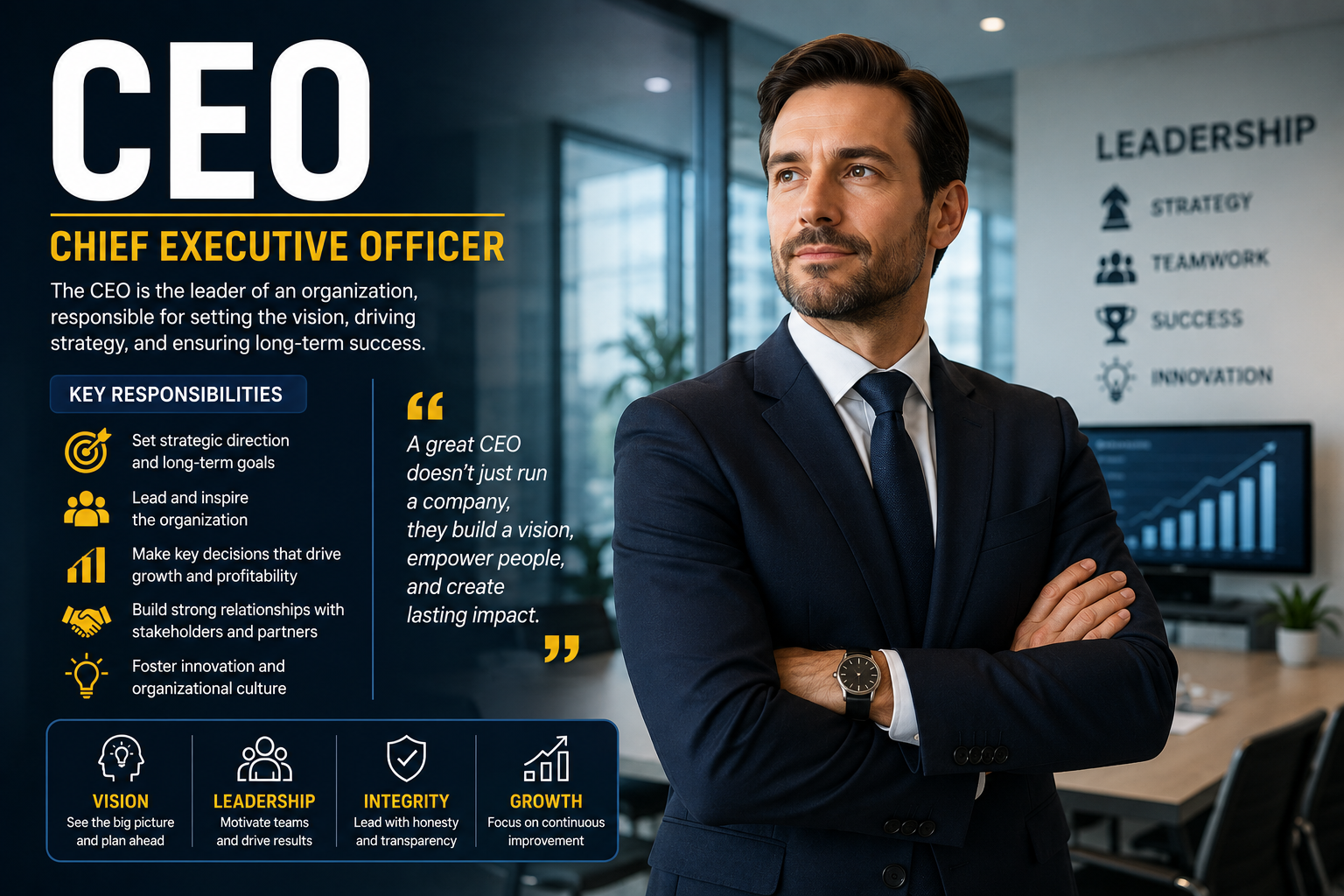
A CEO, or Chief Executive Officer, is the highest-ranking executive in an organization and is responsible for setting the overall direction of the company. Every successful business, whether it’s a startup, a small business, or a multinational corporation, relies on strong leadership to achieve long-term growth. The CEO plays a central role in shaping company strategy, inspiring employees, making high-level decisions, and ensuring the organization remains competitive.
While many people associate CEOs with large corporations and famous business leaders, every organization benefits from executive leadership. A Chief Executive Officer must balance financial performance, innovation, customer satisfaction, employee development, and long-term planning while adapting to changing market conditions.
In this comprehensive guide, we’ll explore what a CEO does, the responsibilities they carry, the skills they need, and how effective leadership contributes to business success.
What Is a CEO?
A CEO, or Chief Executive Officer, is the senior-most executive responsible for managing an organization’s overall operations and strategic direction. Although daily tasks vary depending on the size and industry of the company, the CEO ultimately oversees the business and ensures it moves toward its long-term goals.
In many organizations, the Chief Executive Officer reports to the board of directors while supervising other executives, including the Chief Financial Officer (CFO), Chief Operating Officer (COO), Chief Technology Officer (CTO), and Chief Marketing Officer (CMO). Together, these leaders coordinate different departments to achieve company objectives.
The CEO also serves as the public face of the organization. Investors, customers, employees, business partners, and the media often look to the CEO for leadership, communication, and confidence during both successful periods and challenging times.
Key Responsibilities of a CEO
One of the most important responsibilities of a CEO is creating a clear vision for the organization. The Chief Executive Officer develops long-term strategies that guide business growth while ensuring every department works toward shared objectives.
Decision-making is another major responsibility. CEOs regularly evaluate investments, partnerships, acquisitions, budgets, hiring decisions, and expansion opportunities. These choices often have a significant impact on the company’s future performance.
The CEO is also responsible for building a healthy organizational culture. By promoting collaboration, accountability, innovation, and ethical leadership, they create an environment where employees can perform at their highest potential.
Essential Skills Every CEO Needs
Strong leadership begins with effective communication. A successful CEO must clearly explain goals, motivate employees, negotiate with stakeholders, and represent the company professionally in both internal and public settings.
Strategic thinking is equally important. CEOs must analyze market trends, identify opportunities, evaluate risks, and make decisions that benefit the organization over both the short and long term.
Problem-solving and adaptability are also essential qualities. Business environments constantly change due to technological advancements, economic conditions, customer expectations, and competitive pressures.Chief Executive Officers who remain flexible are better equipped to guide their organizations through uncertainty.
The Daily Life of a CEO
No two days are exactly alike for a CEO. Their schedule typically includes executive meetings, financial reviews, strategic planning sessions, customer discussions, investor communications, and employee engagement activities.
Many Chief Executive Officers spend considerable time reviewing company performance metrics. Financial reports, operational updates, customer satisfaction data, and market research help them evaluate progress toward organizational goals.
Networking also plays an important role. Building relationships with industry leaders, investors, government officials, and business partners creates opportunities for collaboration and long-term growth.
CEO vs. Other Executive Roles
Although the CEO leads the organization, other executives manage specialized areas of the business. Understanding these differences helps clarify how executive leadership functions as a team.
The Chief Financial Officer (CFO) focuses on financial planning, budgeting, investments, accounting, and financial reporting. The CFO ensures the company maintains strong financial health.
The Chief Operating Officer (COO) oversees daily business operations, while the Chief Technology Officer (CTO) manages technology strategy and innovation. The Chief Marketing Officer (CMO) leads branding, advertising, customer acquisition, and marketing initiatives. The Chief Executive Officer coordinates these executives to ensure every department supports the company’s overall vision.
How CEOs Make Strategic Decisions
Strategic decision-making is one of the defining responsibilities of a CEO. Important business decisions rarely rely on instinct alone. Instead, CEOs evaluate data, consult experts, analyze market conditions, and consider long-term consequences.
Risk management is a major part of this process. Every opportunity carries some level of uncertainty, whether launching a new product, entering an international market, or investing in emerging technologies. Effective CEOs balance potential rewards against possible risks.
Successful decision-making also requires collaboration. Chief Executive Officers regularly seek input from executive teams, advisors, employees, and industry specialists before finalizing major initiatives.
Challenges CEOs Face
Leading an organization brings significant challenges. Economic uncertainty, technological disruption, changing customer expectations, and global competition require constant attention from today’s Chief Executive Officer.
Managing people is another ongoing responsibility. Chief Executive Officers must attract talented employees, develop future leaders, resolve workplace conflicts, and maintain high levels of engagement across the organization.
Maintaining innovation while controlling costs can also be difficult. Businesses must continue improving products and services without sacrificing profitability or operational efficiency.
How to Become a CEO
There is no single career path to becoming a Chief Executive Officer, but most successful executives develop extensive experience in leadership, business management, and decision-making over many years.
Many Chief Executive Officers begin their careers in finance, operations, engineering, marketing, sales, or entrepreneurship. As they gain experience, they gradually assume greater management responsibilities and demonstrate their ability to lead teams successfully.
Continuous learning also plays an important role. Executive education, leadership training, industry certifications, and professional networking help future Chief Executive Officers strengthen both technical knowledge and leadership capabilities.
Leadership Qualities That Define Great CEOs
Exceptional CEOs share several important leadership characteristics. Integrity is perhaps the most essential quality because trust forms the foundation of strong relationships with employees, investors, customers, and business partners.
Vision is another defining trait. Great Chief Executive Officers inspire others by communicating a clear direction for the future while encouraging innovation and continuous improvement throughout the organization.
Resilience also distinguishes effective leaders. Business setbacks are inevitable, but successful Chief Executive Officers remain calm under pressure, learn from mistakes, and continue moving their organizations forward with confidence.
The Future Role of CEOs
Technology continues transforming executive leadership. Artificial intelligence, automation, cloud computing, cybersecurity, and data analytics increasingly influence strategic business decisions.
Modern Chief Executive Officers are also expected to focus on sustainability, diversity, employee well-being, and corporate social responsibility. Organizations are judged not only by financial performance but also by their positive impact on society.
As remote work and digital collaboration become more common, Chief Executive Officers must adapt their leadership styles to support distributed teams while maintaining productivity, communication, and organizational culture.
Conclusion
The role of a CEO extends far beyond managing daily operations. As the highest-ranking executive, the Chief Executive Officer provides strategic direction, makes critical business decisions, develops organizational culture, and represents the company to employees, investors, customers, and the public.
Successful Chief Executive Officers combine leadership, communication, financial understanding, strategic thinking, adaptability, and integrity to guide organizations through changing business environments. Their decisions influence every aspect of a company’s performance, from innovation and customer satisfaction to employee engagement and long-term profitability.
Whether leading a startup or a global corporation, an effective Chief Executive Officer serves as the driving force behind sustainable growth, responsible leadership, and lasting business success. As industries continue evolving, strong executive leadership will remain one of the most valuable assets any organization can possess.