


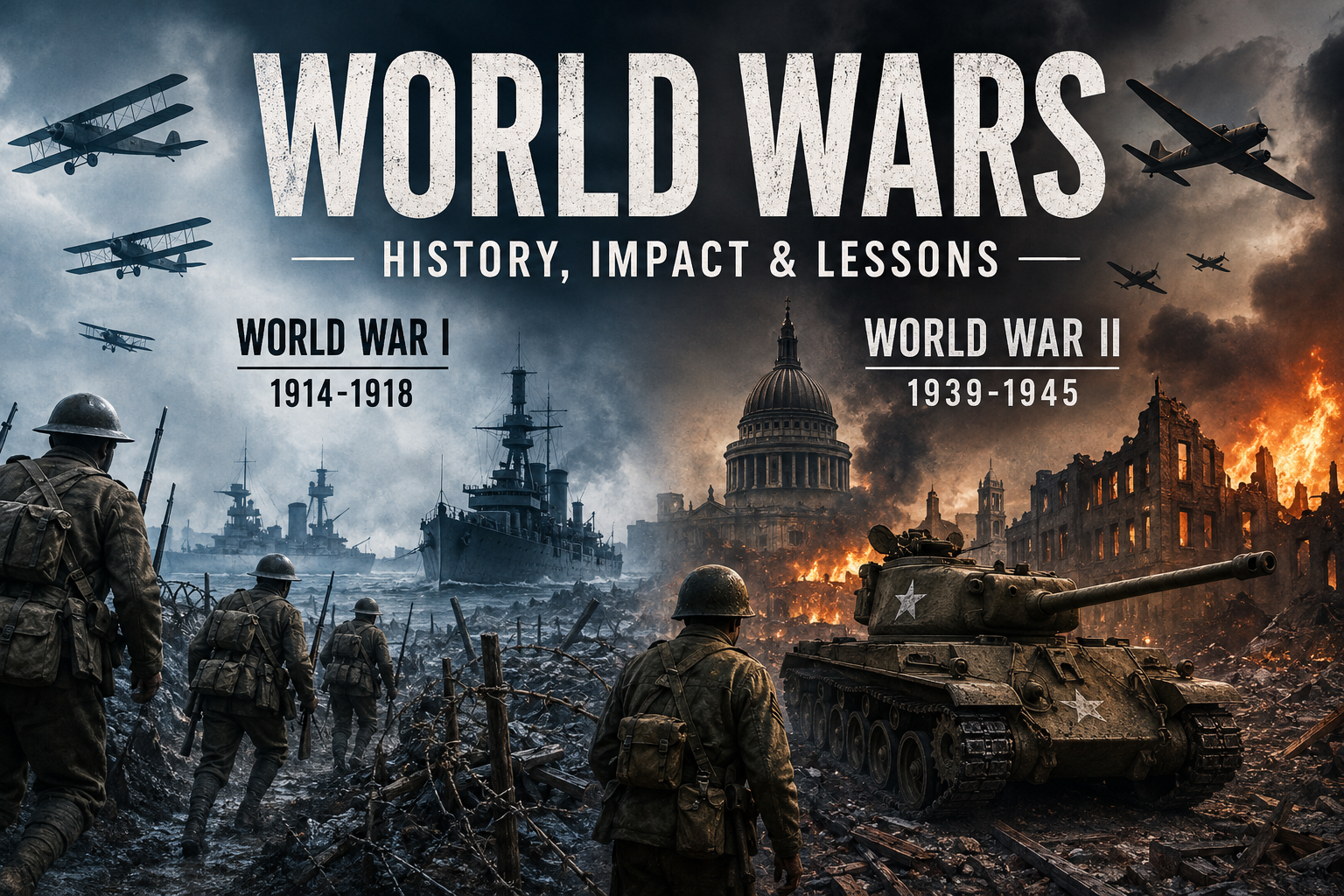
Introduction
The World Wars were among the most significant and devastating events in human history. They reshaped political boundaries, transformed economies, accelerated technological innovation, and changed the way nations interact with one another. The two global conflicts—World War I (1914–1918) and World War II (1939–1945)—involved dozens of countries and affected millions of lives across every continent.
Although both wars happened decades ago, their influence is still visible today. International organizations, military alliances, modern diplomacy, and many national borders were directly shaped by the outcomes of these conflicts. Understanding the World Wars helps us appreciate the importance of peace, cooperation, and international stability.
This article explores the causes, key events, consequences, and lasting legacy of the World Wars while explaining why these historic conflicts continue to matter in today’s world.
What Are the World Wars?
The term World Wars refers to two massive international military conflicts that involved many of the world’s major powers. Unlike regional wars, these conflicts spread across multiple continents and oceans, affecting both military personnel and civilians on an unprecedented scale.
World War I was triggered by rising nationalism, military alliances, imperial competition, and political tensions within Europe. What began as a regional conflict quickly expanded into a global war involving countries from Europe, Asia, Africa, and the Americas. New weapons and trench warfare resulted in devastating casualties.
World War II erupted only two decades later after unresolved political tensions, economic instability, and aggressive territorial expansion by several nations. This conflict became even larger than the first, introducing advanced military technology, large-scale aerial bombing, and widespread civilian suffering. It ultimately reshaped the global balance of power.
The Main Causes of World War I
Several long-term political and economic factors contributed to the outbreak of World War I. European nations were competing for colonies, military strength, and political influence. Rivalries between powerful empires created an environment where even a small conflict could escalate rapidly.
Another important factor was the system of military alliances. Countries promised to defend one another if attacked, creating two major alliance groups. When one nation entered the war, its allies were drawn into the conflict, causing the fighting to spread across Europe and beyond.
The assassination of Archduke Franz Ferdinand of Austria-Hungary in 1914 acted as the immediate trigger. Although the assassination itself was a single event, it ignited long-standing political tensions that had been building for years, eventually leading to a full-scale global war.
Major Events of World War I
World War I was largely fought in trenches stretching across Western Europe. Soldiers faced harsh living conditions, constant artillery fire, disease, and limited movement. Trench warfare became one of the defining characteristics of the conflict.
Several major battles demonstrated the enormous human cost of the war. Millions of soldiers were injured or killed as armies struggled to gain even small amounts of territory. Advances in machine guns, poison gas, tanks, and heavy artillery made combat more deadly than ever before.
The war officially ended in 1918 with the signing of an armistice. The following year, the Treaty of Versailles imposed severe penalties on Germany, redrew European borders, and attempted to establish lasting peace. However, many historians believe the treaty also contributed to tensions that later fueled World War II.
What Caused World War II?
The causes of World War II were complex and developed over many years. Economic hardship following the Great Depression left millions unemployed and created political instability in several countries. This environment allowed extremist governments to gain support.
Aggressive expansion by Germany, Italy, and Japan challenged international peace. Germany sought to reclaim lost territory and expand its influence under Adolf Hitler’s leadership. Similar expansionist goals were pursued by Italy and Japan in their respective regions.
Diplomatic efforts to prevent another global conflict largely failed. The invasion of Poland by Germany in 1939 prompted Britain and France to declare war, officially beginning World War II. Soon afterward, countries from every major continent became involved.
Important Events During World War II
World War II witnessed some of the largest military operations in history. Battles occurred across Europe, North Africa, the Atlantic Ocean, and the Pacific. Air power became increasingly important, and civilians were frequently targeted during bombing campaigns.
The conflict also saw horrific crimes against humanity, including the Holocaust, in which millions of Jewish people and other minority groups were systematically murdered. These events remain among the darkest chapters in modern history and continue to be studied to prevent similar atrocities.
The war ended in 1945 after Germany surrendered in Europe and Japan surrendered following the atomic bombings of Hiroshima and Nagasaki. The conclusion of the war marked the beginning of a new international political order.
The Human Cost of the World Wars
The World Wars caused unimaginable suffering. Tens of millions of soldiers and civilians lost their lives, while countless others experienced injuries, displacement, starvation, and emotional trauma. Families across the world were permanently affected.
Entire cities were destroyed during bombing campaigns and ground battles. Infrastructure, industries, transportation networks, and agricultural systems suffered enormous damage, requiring years of rebuilding after both wars ended.
Beyond physical destruction, the psychological impact lasted for generations. Survivors carried memories of combat, loss, and hardship throughout their lives, influencing literature, education, politics, and public attitudes toward war.
How the World Wars Changed the World
The World Wars dramatically reshaped global politics. Many old empires disappeared, while new nations emerged. Countries reevaluated their foreign policies and began working toward stronger international cooperation to reduce the likelihood of future conflicts.
Scientific and technological advancements accelerated during wartime. Innovations in aviation, medicine, communication, transportation, and manufacturing later found civilian applications, contributing to economic development and modernization around the world.
International organizations were also strengthened after the wars. Global cooperation became increasingly important for addressing conflicts, promoting diplomacy, and encouraging peaceful negotiation between nations.
Lessons Learned from the World Wars
One of the most important lessons from the World Wars is that diplomacy is far less costly than armed conflict. Open communication, peaceful negotiation, and international cooperation help resolve disagreements before they escalate into violence.
The wars also highlighted the importance of protecting human rights. Modern international laws, humanitarian agreements, and war crime tribunals were developed to reduce civilian suffering and hold individuals accountable for serious violations.
Education remains another lasting lesson. By studying the causes and consequences of these conflicts, future generations can better understand the dangers of hatred, extremism, and unchecked political aggression.
Why the World Wars Still Matter Today
Even though the World Wars ended decades ago, their influence remains visible in today’s political, economic, and security systems. Many current international alliances, diplomatic institutions, and military strategies were shaped by experiences from these conflicts.
Historical research continues to uncover new perspectives, helping scholars better understand how political decisions, economic conditions, and social movements contributed to global warfare. These lessons remain valuable for policymakers and educators alike.
Public remembrance through museums, memorials, documentaries, and education ensures that the sacrifices made during the World Wars are not forgotten. Remembering history encourages societies to value peace and work together toward a more stable future.
Conclusion
The World Wars were defining moments in human history that transformed nations, economies, societies, and international relations. While World War I introduced modern industrial warfare, World War II expanded the scale of global conflict and fundamentally reshaped the international order.
Although these wars brought immense destruction and suffering, they also inspired greater international cooperation, technological progress, and stronger commitments to peace and human rights. The lessons learned continue to guide governments, historians, educators, and citizens around the world.
Studying the World Wars is not only about understanding the past—it is also about preparing for a better future. By learning from history, humanity can continue striving toward diplomacy, cooperation, and lasting global peace.