


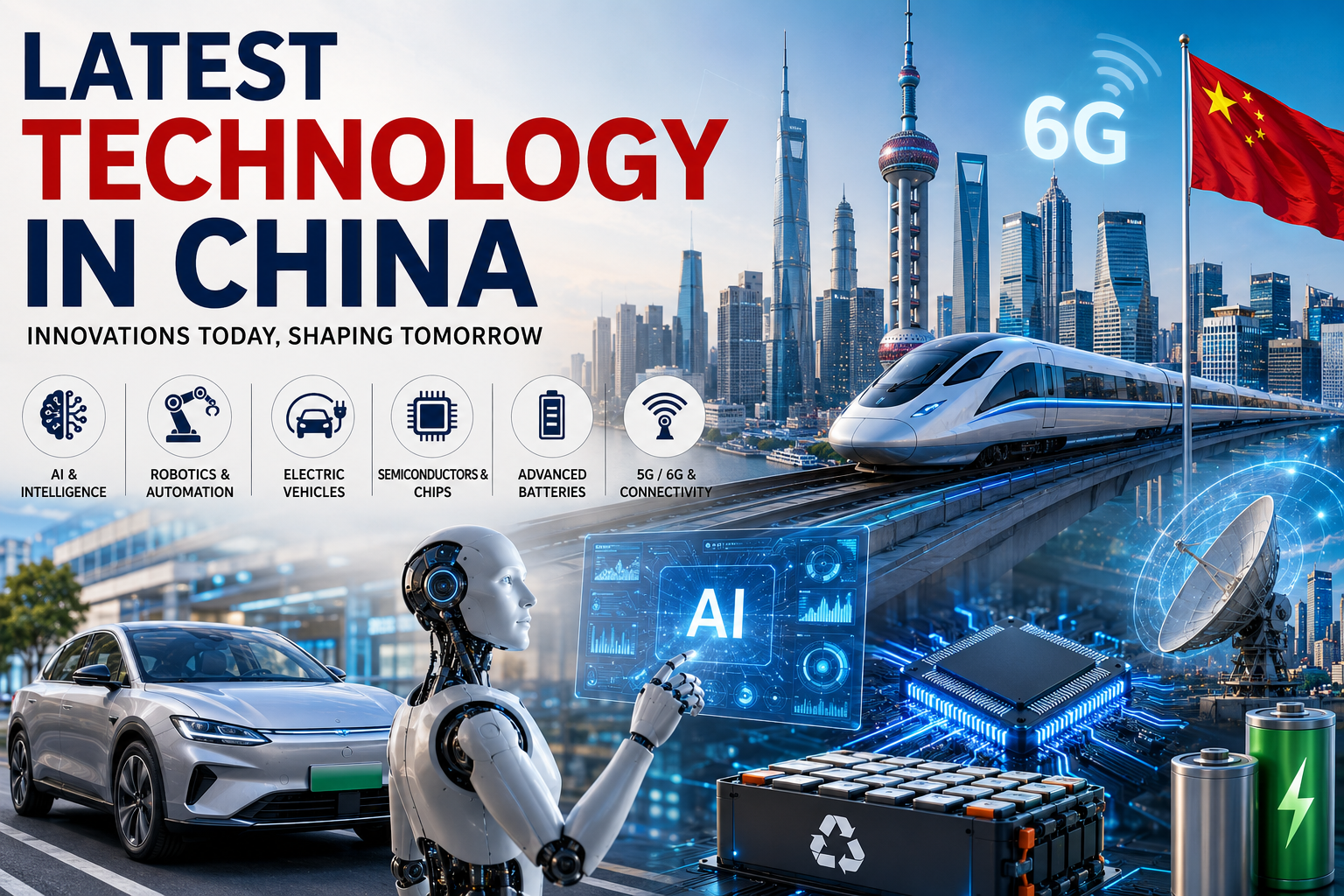
China has become one of the most closely watched technology markets in the world. In 2026,Explore the latest technology in China, from artificial intelligence and humanoid robots to electric vehicles, advanced batteries, semiconductors, quantum computing, and next-generation connectivity. Discover how China’s rapid innovation and advanced manufacturing are shaping the future of technology in 2026.
China’s latest technology push is also closely connected to its broader industrial strategy. The country’s 15th Five-Year Plan for 2026–2030 places significant attention on artificial intelligence, advanced manufacturing, robotics, and technological self-reliance.
What makes China’s approach interesting is the speed at which new technologies can move from laboratories and prototypes into factories and consumer products. From humanoid robots to AI-powered cars, several technologies that once seemed futuristic are already being tested or commercialized across the country.
Artificial Intelligence Is Becoming a Major Technology Driver
Artificial intelligence is probably the biggest part of China’s current technology story. Chinese technology companies are developing large language models, AI assistants, computer-vision systems, and specialized AI applications for industries ranging from manufacturing to healthcare.
China’s current strategy is not simply about creating chatbots. The country is increasingly interested in using AI to improve productivity across the physical economy. Its 2026–2030 planning emphasizes AI applications across areas such as manufacturing, logistics, education, and healthcare, while also encouraging AI agents capable of performing tasks with limited human guidance.
Another important development is the growing connection between AI and China’s enormous manufacturing ecosystem. AI systems can analyze production data, optimize machinery, identify defects, and help companies make faster decisions. This combination of software, industrial infrastructure, and large amounts of real-world data could become one of China’s biggest advantages in the coming years.
Humanoid Robots Are Moving From Demonstrations to Real Work
Humanoid robotics has become one of the most visible areas of technological development in China. At the 2026 World Robot Conference in Beijing, more than 300 companies displayed over 2,000 robotics exhibits, including more than 150 product launches. Many demonstrations focused on practical applications rather than simply making robots perform entertaining tricks.
Chinese companies are developing robots that can sort parcels, assemble electronic components, assist with household tasks, and perform other activities. The goal is to make humanoid robots useful in factories, warehouses, retail environments, and eventually homes. This represents a major change from the early days of robotics, when many demonstrations were primarily designed to show movement and mechanical ability.
The industry still has plenty of challenges. Current humanoid robots can be expensive, and their ability to perform complicated tasks independently remains limited. Reuters reported that some industry participants believe a major breakthrough in robot intelligence could still be several years away. Even so, China’s ability to manufacture hardware quickly and test robots in real environments could help accelerate development.
Electric Vehicles Are Becoming Smarter
China is already a major force in electric vehicles, but the latest development is that cars are increasingly becoming software-driven technology platforms. Modern Chinese EVs can combine electric powertrains with advanced driver-assistance systems, connected services, intelligent cockpits, and AI-based features.
Chinese automakers are also moving deeper into batteries, semiconductors, and artificial intelligence. Industry discussions in 2026 have highlighted the growing integration of these technologies as manufacturers compete not only on vehicle production but also on higher-value innovation.
The result is a different idea of what a car can be. Instead of treating electronics and software as secondary features, manufacturers are building vehicles around them. Smart dashboards, voice assistants, over-the-air updates, sensors, and increasingly sophisticated driving systems are becoming central parts of the vehicle experience. This trend could influence the global automotive industry as Chinese EV companies expand their technology and products into international markets.
Battery Technology Is Developing Rapidly
Battery technology is another area where China’s manufacturing strength is having a major impact. The country has developed a large ecosystem covering battery materials, cell production, electric vehicles, energy storage, manufacturing equipment, and recycling.
In 2026, attention is increasingly turning toward next-generation battery technologies rather than relying exclusively on conventional lithium-ion designs. Industry exhibitions in China are showcasing technologies including solid-state batteries, sodium-ion batteries, flow batteries, advanced lithium systems, and new manufacturing equipment.
Better batteries matter far beyond electric cars. Energy-storage systems can help support renewable electricity, stabilize power networks, and provide backup energy for businesses and homes. If Chinese manufacturers can continue reducing costs while improving energy density, charging speed, safety, and durability, battery innovation could become one of the country’s most important technological exports.
China Is Pushing Harder Into Semiconductors
Semiconductors remain one of the most strategically important technology areas for China. Advanced chips are essential for AI, smartphones, electric vehicles, robotics, telecommunications, and modern industrial equipment.
International restrictions on access to some advanced semiconductor technologies have increased pressure on Chinese companies to develop domestic alternatives. This has encouraged investment in chip design, manufacturing, packaging, memory, and other parts of the semiconductor supply chain. However, China’s semiconductor progress should not be confused with complete independence. Analysts continue to point out that companies in the United States, Taiwan, the Netherlands, Japan, and other countries retain important advantages in advanced chip design, manufacturing, and equipment.
At the same time, China is looking beyond traditional semiconductor technologies. Recent regulatory developments have broadened attention toward technologies such as photonic and quantum chips, suggesting that the country’s technology policy is preparing for future computing architectures as well as today’s conventional chips. This could become increasingly important as AI requires ever greater computing power.
Quantum Computing and Other Future Technologies
China is also investing in technologies that are not yet part of everyday life but could become extremely important in the future. Quantum computing is one of these areas, alongside advanced communications, brain-computer interfaces, and next-generation materials.
Quantum technology is particularly interesting because it could eventually provide new approaches to solving certain complex computational problems. Researchers around the world are competing to improve quantum processors, error correction, networking, and practical applications. China’s continued investment shows that its technology strategy is not limited to industries that already generate large amounts of revenue.
The same long-term approach can be seen in areas such as 6G communications and brain-computer interfaces. These technologies are still developing, and many proposed applications remain experimental. China’s 2026–2030 technology agenda nevertheless identifies several of these emerging fields as strategic areas for future development.
Advanced Manufacturing Is Connecting Everything Together
One of the most important things to understand about China’s technology progress is that individual technologies do not operate in isolation. AI, robotics, batteries, electric vehicles, chips, and manufacturing are increasingly connected.
For example, an electric vehicle can use AI software, locally developed chips, advanced batteries, intelligent sensors, and automated manufacturing systems. A factory can use robots powered by AI while collecting large amounts of production data that can later be used to improve those same AI systems. This creates a technology ecosystem in which improvements in one industry can support progress in another.
This approach is already affecting China’s regional economies. Reuters reported that provinces with strong high-tech manufacturing sectors, including Guangdong, Zhejiang, Shanghai, Anhui, and Shandong, performed strongly in the first half of 2026, with industries such as semiconductors, electric vehicles, AI, and robotics contributing to their growth.
Why China’s Technology Development Matters Globally
China’s technology progress matters because the country is not only developing products for its domestic market. Chinese companies are competing internationally in electric vehicles, batteries, consumer electronics, telecommunications equipment, renewable-energy technologies, robotics, and other sectors.
This creates opportunities as well as competition for businesses around the world. Lower-cost Chinese technology can make advanced products more accessible, while rapid innovation can force companies in other countries to improve their own products and manufacturing processes.
At the same time, geopolitical tensions remain an important factor. Restrictions on technology exports, supply-chain concerns, national-security policies, and competition between China and other major technology powers can influence which products reach international markets. The global technology industry is therefore becoming more interconnected in some ways and more divided in others.
What the Future of Chinese Technology Could Look Like
The most interesting part of China’s technology story may be what happens when AI, robotics, advanced manufacturing, and intelligent vehicles become more deeply integrated. A factory could potentially use AI to plan production, robots to perform physical tasks, smart machines to monitor quality, and autonomous systems to move goods around the facility.
Humanoid robots could also become more practical if improvements in AI allow them to understand unfamiliar environments and perform complicated tasks without constant human control. Industry leaders have described this possibility as a potential “ChatGPT moment” for robotics, although current systems still face major technical and commercial challenges.
The next few years will therefore be less about one spectacular invention and more about deployment. China’s biggest advantage may come from its ability to connect research, manufacturing, supply chains, large domestic markets, and government-supported industrial priorities. Whether every ambitious technology succeeds is impossible to know, but the direction is clear: China is investing heavily in turning emerging technologies into practical products and services.
Final Thoughts
The latest technology in China in 2026 is much broader than smartphones or consumer electronics. Artificial intelligence, humanoid robots, electric vehicles, batteries, semiconductors, quantum technologies, and advanced manufacturing are all becoming important parts of the country’s technology ecosystem.
Some of these technologies are already commercially useful, while others remain experimental. Humanoid robots, for example, have made impressive progress but still need to prove that they can perform useful work economically and reliably. Semiconductor development has also advanced, but China continues to face major challenges in obtaining or replacing some of the world’s most advanced chipmaking technologies.
For consumers, businesses, and technology enthusiasts, China’s progress is worth watching closely. The country’s combination of manufacturing capacity, investment, engineering talent, and large-scale technology deployment could shape global innovation throughout the rest of the decade. The most important question is no longer whether China is becoming a major technology power—it is how far these technologies can move from impressive demonstrations into reliable, affordable, everyday applications.



garments manufacturer